What Makes a Good Career Aptitude Test? Key Quality Criteria
If you are navigating a major career transition or choosing a college major, finding a reliable evaluation tool is often your best first step. However, the internet is flooded with quick, superficial quizzes that promise instant answers but deliver little real value. To protect your time and emotional energy, you need to know how to filter the noise from the science.
This comprehensive guide breaks down exactly what makes a good career aptitude test, exposing the core quality criteria—such as psychological validity and framework stability—you must look for before trusting any assessment with your professional future. You can easily check your traits and explore our RIASEC test online to begin your self-discovery journey with a scientifically validated framework.

1. Beyond the Magic Answer: What Is a "Good" Career Aptitude Test?
Many people search online hoping to find a computer program that tells them exactly what to do with their lives. They treat automated questionnaires like digital crystal balls. However, a genuinely effective vocational tool does not predict your future or hand you a single, rigid job title.
Instead, a good career aptitude test provides a structured blueprint of your personal behavioral tendencies and professional preferences. It functions as a supportive mirror rather than an absolute decision-maker.
The Difference Between Scientific Frameworks and Pop-Psychology Quizzes
Pop-psychology quizzes often rely on superficial questions designed for entertainment. They ask about your favorite colors or your ideal vacation spots to guess your perfect workplace. These quizzes lack a steady baseline and usually reflect your temporary mood rather than your enduring personality.
In contrast, an authentic assessment utilizes rigorous psychometric design to evaluate how you prefer to interact with ideas, people, data, and physical objects. It looks at long-term behavioral patterns that remain stable across different life stages.
The Role of Comprehensive Interest Inventories over Single Job Titles
A quality evaluation delivers a dynamic profile of your professional inclinations. For instance, rather than telling you to become an accountant, it highlights your strong preference for structured data environments and organized systems. This systematic classification opens up dozens of parallel career tracks. By focusing on deep vocational traits, a valid interest inventory helps you understand the underlying environmental factors that keep you engaged, productive, and satisfied at work over long periods.
2. The Science of Assessment: How to Evaluate Test Accuracy and Reliability
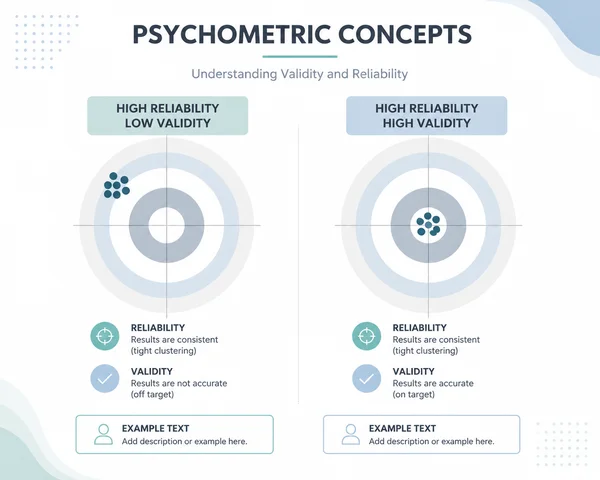
Understanding the scientific foundation of an assessment helps you determine if its results deserve your trust. Psychologists judge the value of any evaluation tool using two primary technical benchmarks: reliability and validity. Let us demystify these terms using simple, everyday analogies so you can judge any online tool like a seasoned expert.
Psychometric Reliability: Does the Test Produce Consistent Scores?
Think of reliability as a standard bathroom scale. If you step on it three times within five minutes, it should display the exact same number each time. If the numbers fluctuate wildly, the scale is broken.
A reliable career interest assessment works the exact same way. If you take the evaluation today and repeat it next week under similar conditions, your core interest profile should remain highly consistent. Rapidly shifting results are a clear warning sign of a poorly constructed questionnaire.
Construct Validity: Is It Actually Measuring Your Vocational Traits?
Validity determines whether the tool actually measures what it claims to measure. Imagine using that same bathroom scale to measure your height; it might give you a highly consistent number, but that number represents your weight, not your stature. Therefore, the scale lacks validity for height measurement.
A valid career test must isolate your deep, stable vocational interests rather than measuring your temporary technical skills or temporary employer compliance.
A 4-Point Quick Checklist Before You Take Any Career Test
Before you dedicate twenty minutes to answering online questionnaire options, run the platform through this quick evaluation checklist to verify its professional integrity:
- Theory-Backed Design: Does the platform explicitly state its scientific methodology, such as John Holland's RIASEC framework or O*NET datasets?
- No Forced Labeling: Does the report present your traits as a blended combination of themes rather than shoving you into a reductive, one-dimensional box?
- Multi-dimensional Profiles: Does the tool measure balanced variations across distinct interest spheres instead of scoring a single binary preference?
- Visible Professional Disclaimers: Does the website host transparent, ethical statements clarifying that the tool is an educational aid rather than a formal clinical diagnosis?
3. Free vs. Paid Assessments: Finding the Best Aptitude Test for Your Needs
A common misconception is that an assessment must be highly accurate simply because it costs hundreds of dollars. While proprietary clinical assessments administered by licensed psychologists have immense value for deep behavioral analysis, open-source frameworks offer extraordinary accuracy for initial career mapping.
The most robust free tools are built directly upon extensive public research databases, such as the U.S. Department of Labor’s O*NET system. These platforms leverage decades of statistical validation gathered from millions of working professionals. When exploring your options to find the best aptitude test for your personal situation, consider this comparative layout:
| Evaluation Feature | Open-Source Frameworks (e.g., O*NET / RIASEC) | Proprietary Clinical Tools (Corporate Evaluations) |
|---|---|---|
| Primary Financial Cost | Usually free and universally accessible online | Ranges from $50 to over $400 per evaluation |
| Core Theoretical Model | Transparently disclosed and publicly validated | Proprietary algorithms kept behind corporate walls |
| Typical Completion Time | Highly efficient, usually requiring 5 to 20 minutes | Extended questionnaires, often taking 1 to 2 hours |
| Primary Practical Output | Immediate multi-letter interest code with career links | Delayed multi-page breakdown requiring expert interpretation |
If you are an adult seeking an efficient way to brainstorm a career pivot, utilizing a validated free RIASEC test provides exceptional utility without any financial risk. It allows you to gather baseline data before deciding whether to invest in high-priced premium consultations.
4. Demystifying the Scores: How to Map Your Insights to Real-World Career Paths
Receiving your final score report can feel overwhelming if you do not know how to translate abstract scores into real-world choices. High-quality systems provide clear pathways to turn your raw data into clear, actionable career exploration steps.
Decoding Three-Letter Interest Profiles (The Holland Code Approach)
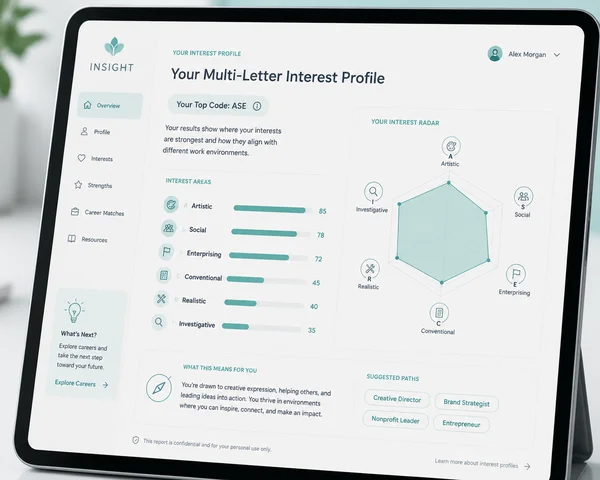
The gold standard of vocational mapping uses a combined three-letter code to summarize your top three interest areas. For example, if your report reads "SEC" (Social, Enterprising, Conventional), it means you thrive when helping individuals, directing projects, and engineering organizational order.
This specific combination guides you toward roles like educational administrator, human resource manager, or corporate trainer. It looks at how your traits interact as a coherent ecosystem rather than treating each score in isolation.
Portable Reports: Using Your Test Results PDF as a Structured Discussion Starter
A premium feature to look for in any assessment is the ability to export your findings into a clean document. Saving your good career aptitude test pdf report allows you to create a concrete archive of your professional preferences over time.
This document tracks your evolving alignment with changing market trends. Reviewing this data side-by-side with prior years helps you pinpoint exactly which environmental stressors or task types trigger workplace burnout.
From Score to Action: How to Discuss Results with a Career Advisor
An online report is a phenomenal launchpad, but it gains massive leverage when combined with human expertise. Treat your digital summary as a structured conversation starter rather than a final verdict. Bring your summary report to an academic advisor or corporate mentor, and use these precise discussion prompts to unpack your findings:
- "My report shows a high alignment with investigative and artistic environments. How do these dual themes manifest within our current department or industry?"
- "I noticed my lowest score is in conventional tasks. What strategies can we implement to ensure my daily routine doesn't get bogged down by administrative fatigue?"
- "Based on my multi-letter interest profile, which specific professional development courses or cross-department projects would allow me to leverage my core strengths?"
5. Empowering Your Next Step: An Open Framework for Structured Self-Reflection
If you want to step away from confusing corporate jargon and generic internet clickbait, you deserve an honest environment designed for genuine self-discovery. A high-quality evaluation should remove unnecessary barriers, letting you examine your professional tendencies safely, instantly, and without hidden financial strings.
You can read endless theory about vocational psychology, but nothing compares to seeing your personal traits mapped out systematically in a comprehensive report. If you are ready to gain real clarity about your professional strengths, you can easily access a structured career interest assessment on our homepage. This open-source framework evaluates your alignment across six foundational occupational themes, generating an actionable three-letter code tailored specifically to your background.
It functions entirely as an educational self-reflection questionnaire, giving you an immediate baseline to explore alternative industries, optimize your resume, or prepare for meaningful conversations with professional counselors.
*Disclaimer: This digital assessment platform provides educational and informational resources intended solely for self-reflection and exploratory support. It does not constitute formal clinical diagnosis, psychological evaluation, or binding professional vocational counseling.*
Turning Test Insights Into Systematic Lifelong Exploration
Your vocational interests are not permanently carved into stone on the day you take a test. Human beings are dynamic, adaptive organisms; your values, skills, and preferences will naturally mature as you gain life experience and navigate different workplace environments.
Treat your interest profile as an evolving compass rather than a restrictive identity tag. Use these insights to navigate your current transitions with confidence, but remain entirely open to new industries as your skills expand. When you understand the core environments that feed your curiosity, you transform career planning from a source of anxiety into a systematic, predictable journey of lifelong exploration.
Frequently Asked Questions
Is 80% good for an aptitude test?
Vocational interest inventories do not use a standard academic grading system, so a percentage score never indicates passing or failing. When a report shows an 80% match for a specific theme, it simply indicates a strong statistical correlation between your answers and that specific work environment. It shows a clear preference for those types of daily tasks, not your intelligence or technical capability.
What specific good career aptitude test questions should I expect?
High-quality tests rarely ask you about specific job titles. Instead, they present simple, action-oriented questions regarding daily tasks. For example, you might be asked to rate how much you would enjoy "repairing an electrical appliance," "interpreting laboratory data," or "organizing a corporate filing system." These behavioral prompts help isolate your natural interest patterns from external societal pressures.
Is a good career aptitude test worth it according to Reddit communities?
Online communities on Reddit generally agree that career questionnaires are highly valuable if you treat them as structured brainstorming mirrors rather than magical decision-makers. Users often note that taking an established, theory-backed evaluation helps them name specific sources of workplace dissatisfaction. The consensus advice from these discussions is to skip flashy, unverified pop-quizzes and focus entirely on validated open-source models that map directly to real-world career databases.