Autism Disorders Types – A Clear Guide to the Spectrum
You may have seen terms like "Asperger's," "classic autism," or "Level 1 autism" and wondered what they all mean. The language around autism disorders types has changed significantly, and it can feel confusing—especially if you are exploring these topics for yourself or someone you care about. If you want a starting point for self-reflection, you can explore the Aspie Quiz to learn more about autism-related traits. This guide walks you through every major classification, from the five historical types to the three current DSM-5 support levels. You will get clear definitions, a side-by-side comparison of old and new categories, and practical next steps for understanding the autism spectrum.
What Is Autism Spectrum Disorder?
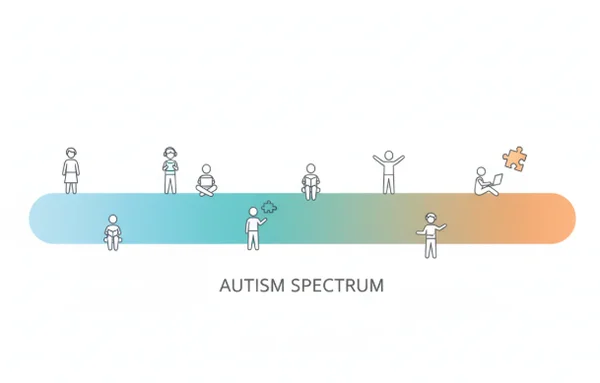
Autism spectrum disorder (ASD) is a neurodevelopmental condition that affects how a person communicates, interacts with others, and experiences the world. It is not a single condition with one fixed set of symptoms. Instead, it spans a wide range of traits, strengths, and challenges.
Why Autism Is Called a Spectrum
The word "spectrum" reflects the diversity within autism. Two people with ASD can look very different from each other. One person may need minimal daily support, while another may need help with nearly every activity. Because of this wide range, professionals moved away from rigid labels and toward a spectrum-based understanding.
Think of it like a color wheel rather than a single shade. Your combination of social communication patterns, sensory experiences, and behavioral traits creates a profile that is uniquely yours.
Core Traits Across the Autism Spectrum
Despite this diversity, most people on the autism spectrum share certain core traits in varying degrees:
- Social communication differences — difficulty reading social cues, body language, or tone of voice
- Repetitive behaviors or routines — strong preference for sameness, specific rituals, or focused interests
- Sensory sensitivities — over- or under-reactions to sounds, textures, lights, or other sensory input
These traits exist on a continuum. Some may be subtle and only noticeable in certain situations. Others may be obvious and affect daily functioning in significant ways.
What Were the 5 Historical Types of Autism?
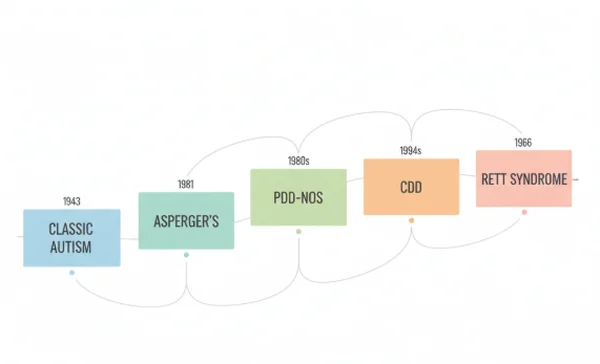
Before 2013, clinicians used five separate diagnoses. Understanding these types of autism spectrum disorders helps you make sense of older records, research, and conversations. While these autism disorders types are no longer used as distinct diagnoses, the terminology still appears frequently.
Autistic Disorder (Classic Autism)
This was the most recognized form. People diagnosed with autistic disorder typically showed significant challenges in social interaction, verbal and nonverbal communication, and repetitive behaviors. Symptoms usually appeared before age three.
In today's framework, many individuals who would have received this diagnosis now fall under Level 2 or Level 3 ASD.
Asperger's Syndrome
Asperger's syndrome described individuals with average or above-average intelligence who had typical language development but struggled with social interactions. They often had intense, focused interests and preferred structured routines.
Because language delay was not present, Asperger's was sometimes called "mild" or "high-functioning" autism. However, the challenges were real and could significantly affect relationships and daily life.
PDD-NOS (Pervasive Developmental Disorder–Not Otherwise Specified)
PDD-NOS was a "catch-all" diagnosis. It applied to people who showed some autism-related traits but did not meet the full criteria for autistic disorder or Asperger's syndrome. Symptoms varied widely from person to person.
This diagnosis often caused confusion because it was loosely defined. As a result, it was one of the main reasons professionals restructured autism classification.
Childhood Disintegrative Disorder
Childhood disintegrative disorder (CDD) was a rare and severe condition. Children with CDD developed normally for at least two years and then experienced a rapid loss of previously acquired skills—including language, social abilities, and motor coordination.
CDD is now considered part of the broader autism spectrum under the DSM-5. However, its distinct pattern of regression still helps clinicians identify it.
Rett Syndrome and Its Reclassification
Rett syndrome was once grouped with autism disorders types because of overlapping symptoms in early childhood, such as loss of hand skills and social withdrawal. However, it is caused by a specific genetic mutation (the MECP2 gene).
Because of this known genetic cause, Rett syndrome is no longer classified as an autism spectrum disorder. It is now recognized as a separate neurological condition.
How Does the DSM-5 Classify Autism Today?
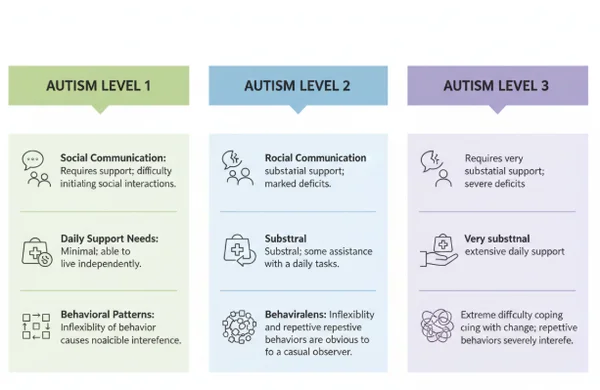
In 2013, the DSM-5 replaced all five historical types of autism spectrum disorders with a single diagnosis: autism spectrum disorder. Instead of separate categories, the DSM-5 uses three support levels based on how much help a person needs in daily life.
Level 1 – Requiring Support
People at Level 1 can often manage daily tasks independently. However, they may struggle to start or maintain conversations, read social cues, or adapt to unexpected changes. Repetitive behaviors may interfere with functioning in some contexts.
Level 1 roughly corresponds to what was previously called Asperger's syndrome or "high-functioning autism." However, the challenges at this level are still meaningful and can affect relationships, work, and well-being.
Level 2 – Requiring Substantial Support
At Level 2, social difficulties become more noticeable even with support in place. Verbal communication may be limited, and repetitive or restricted behaviors occur frequently. Changes in routine can cause significant distress.
People with Level 2 autism often benefit from structured environments, consistent schedules, and dedicated support at school or work.
Level 3 – Requiring Very Substantial Support
Level 3 represents the highest support needs on the autism spectrum. People at this level have severe challenges in both verbal and nonverbal communication. They may initiate very few social interactions and respond minimally to others.
Flexibility is extremely difficult, and restricted or repetitive behaviors significantly interfere with daily functioning. Round-the-clock support is often necessary.
What the Support Levels Actually Mean in Daily Life
The levels describe support needs—not a person's worth or potential. Here is a practical summary:
| Level | Support Needed | Social Communication | Daily Functioning |
|---|---|---|---|
| Level 1 | Moderate | Difficulty with social cues; can communicate independently | Generally independent with some challenges |
| Level 2 | Substantial | Limited verbal skills; noticeable social difficulties | Needs structured support in most settings |
| Level 3 | Very Substantial | Severe deficits in verbal and nonverbal communication | Requires continuous, intensive support |
These levels are not permanent labels. A person's support needs can shift over time depending on environment, skills development, and available resources.
Key Differences Between Old Types and Current Levels
One of the most common questions about autism disorders types is how the old categories connect to the new framework. Here is a clear mapping to reduce confusion.
How Former Diagnoses Map to DSM-5 Levels
| Former Diagnosis | Approximate DSM-5 Equivalent |
|---|---|
| Asperger's Syndrome | Level 1 ASD (Requiring Support) |
| PDD-NOS | Level 1 or Level 2 ASD (varies by individual) |
| Autistic Disorder (Classic) | Level 2 or Level 3 ASD |
| Childhood Disintegrative Disorder | Typically Level 3 ASD |
| Rett Syndrome | No longer classified as ASD |
Keep in mind that these mappings are approximate. Each person's profile is unique, and the DSM-5 levels focus specifically on support needs rather than categorical labels.
Why the Shift from Types to a Spectrum Matters
The shift matters because rigid categories often forced individuals into boxes that did not fit their experience. For example, someone labeled "high functioning" might still struggle with daily tasks that others take for granted.
By focusing on a spectrum with support levels, the current system:
- Acknowledges the wide diversity of autism presentations
- Reduces stigma attached to specific labels
- Helps clinicians tailor support plans to the individual
- Encourages a strengths-based approach alongside challenge identification
For you, this means that a label is less important than understanding your own patterns, needs, and strengths.
What Happened to Asperger's Syndrome?
Asperger's syndrome was merged into autism spectrum disorder when the DSM-5 was published in 2013. Before that, it was a standalone diagnosis primarily given to people who had typical language development and average or above-average cognitive abilities but experienced notable social difficulties.
The reasons for the change include:
- Inconsistent application — Different clinicians used different thresholds for Asperger's vs. autistic disorder, leading to uneven diagnoses.
- Artificial boundary — Research showed no clear biological line separating Asperger's from other autism presentations.
- Spectrum reality — Traits once labeled "Asperger's" fit naturally within Level 1 of the autism spectrum.
Many people who were diagnosed with Asperger's before 2013 still use the term as part of their identity. There is nothing wrong with that. The label now falls under autism spectrum disorder type 1 (Level 1) in clinical settings, but personal identity and clinical labels can coexist.
How Self-Reflection Can Help You Understand Your Traits
Learning about autism disorders types is a valuable first step. However, reading about categories and levels can only take you so far. At some point, you may want to connect what you have learned to your own experiences.
Why Exploring Your Traits Is a Valuable Next Step
Self-reflection is not about labeling yourself. Instead, it is about organizing your thoughts and noticing patterns. You might ask yourself questions like:
- Do I find social situations draining or confusing in ways that others do not seem to?
- Do I have intense interests that are deeply important to me?
- Am I more affected by sensory input—sounds, lights, textures—than people around me?
- Do unexpected changes in plans cause me significant stress?
These questions are not diagnostic. They are starting points for honest reflection.
What a Self-Reflection Tool Can (and Cannot) Do
A self-reflection tool, like the one available on AspieQuiz.org, can help you organize your observations. It provides structured questions designed to help you think about patterns in your behavior, sensory experiences, and social interactions.
What it can do:
- Help you notice patterns you may not have considered
- Give you language to describe your experiences
- Offer a starting point for conversation with a professional
What it cannot do:
- Provide a clinical diagnosis
- Replace a professional evaluation
- Tell you whether you "are" or "are not" autistic
This tool is designed for educational self-reflection only. It is not a diagnostic instrument and does not replace professional assessment.
Where Understanding the Autism Spectrum Begins
The landscape of autism disorders types has changed, but the core message remains the same: autism is a spectrum, and every individual's experience is different.
Here are the key takeaways from this guide:
- Five historical types (autistic disorder, Asperger's, PDD-NOS, CDD, and Rett syndrome) were once separate diagnoses. They have since been consolidated.
- Three DSM-5 levels now describe autism by support needs: Level 1, Level 2, and Level 3.
- Old labels map roughly to new levels, but each person's profile is unique.
- Asperger's syndrome is now part of Level 1 ASD, though many people still identify with the term.
- Self-reflection is a powerful tool for understanding your own traits—but it is not a substitute for professional evaluation.
If any of these descriptions resonated with you, consider taking the next step. You can try the Aspie Quiz online as a starting point for self-understanding, or speak with a healthcare professional who specializes in autism spectrum assessment.
Frequently Asked Questions
What type of disorder is autism?
Autism is a neurodevelopmental disorder. It affects social communication, interaction, and behavior across a wide spectrum. The DSM-5 classifies it as autism spectrum disorder (ASD), recognizing that traits and support needs vary greatly from person to person.
How many types of autism disorders are there?
Historically, there were five types of autism spectrum disorders: autistic disorder, Asperger's syndrome, PDD-NOS, childhood disintegrative disorder, and Rett syndrome. Since 2013, these have been unified into one diagnosis—autism spectrum disorder—with three support levels.
Is ADHD a form of autism?
No, ADHD and autism are separate neurodevelopmental conditions. However, they frequently co-occur. Some traits overlap—such as difficulty with attention or social interactions—which is why they are sometimes confused. A professional evaluation can help distinguish between them.
Can a person be autistic and not know it?
Yes. Many adults, especially those who have developed coping strategies over time, may not realize their experiences align with autism spectrum traits. This is particularly common among women and people who were socialized to mask their differences.
What is the difference between high-functioning and low-functioning autism?
These are informal terms, not official diagnoses. "High-functioning" generally refers to individuals with Level 1 support needs, while "low-functioning" may describe those at Level 3. However, many advocates discourage these labels because they oversimplify a person's real challenges and strengths.
When might it be helpful to speak with a professional about autism?
If autism-related traits affect your daily life, relationships, work, or emotional well-being, speaking with a qualified professional can offer clarity and tailored support. A formal evaluation is not about getting a label—it is about understanding yourself better and accessing resources that can help.